
This post contains affiliate links. If you buy through them we may earn a commission at no extra cost to you.
Last updated: October 22, 2026
The history of the electric car begins earlier than most people realize. Electric cars are actually older than the gasoline car most of us grew up with. Inventors built crude battery-powered carriages in the 1830s, practical electric cars appeared around 1890, and by 1900 they were among the most popular cars in America, before cheap gasoline cars pushed them aside for most of the 20th century.
The comeback started with the 1970s oil crises, gathered pace with California’s clean-air rules and the GM EV1 in the 1990s, and went mainstream with Tesla, the Nissan Leaf and China’s carmakers. By 2025, according to the IEA Global EV Outlook 2026, more than 20 million electric cars were sold worldwide, about one in four new cars.
Key takeaways
- Electric cars date back to around the 1830s, decades before Karl Benz’s 1886 gasoline Motorwagen.
- Around 1900, electric cars made up roughly a third of US automobiles, by most estimates.
- Henry Ford’s affordable Model T (1908) and the electric self-starter (1912) helped gasoline cars win.
- Oil shocks in the 1970s and California’s 1990 zero-emission rule revived interest.
- Modern lithium-ion electric cars took off after the Tesla Roadster (2008), Nissan Leaf (2010) and Tesla Model S (2012).
- In 2025 global electric car sales passed 20 million (about 25% of new cars), led by China.
In this article
- The 1830s-1890s: Who invented the electric car?
- The early 1900s: The first golden age of the electric car
- Why did electric cars disappear? The decline from around 1910
- The 1970s: Oil crises spark a revival
- The 1990s: Clean-air rules and the GM EV1
- 1997-2000s: The Toyota Prius makes hybrids mainstream
- 2008-2012: Tesla and lithium-ion change the game
- 2010s: The Nissan Leaf and the first mass-market electric cars
- China’s rise and BYD’s surge
- 2025-2026: Where the electric car stands today
- Electric car history: the full timeline
- Then vs. now: How much have electric cars improved?
- Frequently asked questions
- The bottom line
The 1830s-1890s: Who invented the electric car?
No single person invented the electric car. As the US Department of Energy history puts it, it grew out of a chain of breakthroughs in batteries and electric motors across the 1800s, in Hungary, the Netherlands, the UK and the US.
Early experiments (around 1828-1840)
Hungarian priest-physicist Ányos Jedlik built a tiny model vehicle driven by an electric motor around 1828. In Scotland, Robert Anderson is usually credited with a crude electric carriage sometime in the 1830s, though sources disagree on the exact year (dates from 1832 to 1839 are quoted). With non-rechargeable batteries, these were curiosities rather than transport.
Rechargeable batteries change everything (1859-1880s)
The key enabler was the lead-acid battery, invented by French physicist Gaston Planté in 1859 and improved by Camille Faure in 1881. Rechargeable cells meant a vehicle could be used, plugged back in and used again. By the 1880s, inventors in France and Britain, including Gustave Trouvé and Thomas Parker, were building working electric tricycles and cars.
William Morrison and America’s first electric car (around 1890)
In the United States, chemist William Morrison of Des Moines, Iowa, built what the DOE calls the first successful American electric car, appearing around 1890. It was essentially an electrified wagon carrying six passengers at up to about 14 mph (around 23 km/h).
The early 1900s: The first golden age of the electric car
At the turn of the century, buyers had three choices: steam, gasoline or electric. Steam cars took a long time to start in cold weather and needed water. Gasoline cars were loud, smelly, vibrated heavily and had to be started with a dangerous hand crank.
Electric cars, by contrast, were quiet, clean and easy to drive, with no gears to shift. That made them especially popular with wealthy urban drivers. According to McKinsey, US companies built about 4,200 cars in 1900, with an estimated split of 40% steam, 38% electric and 22% gasoline. The DOE describes electric cars as accounting for around a third of all vehicles on the road at their peak. Figures vary by source and year (1900 or 1901), so treat them as estimates.
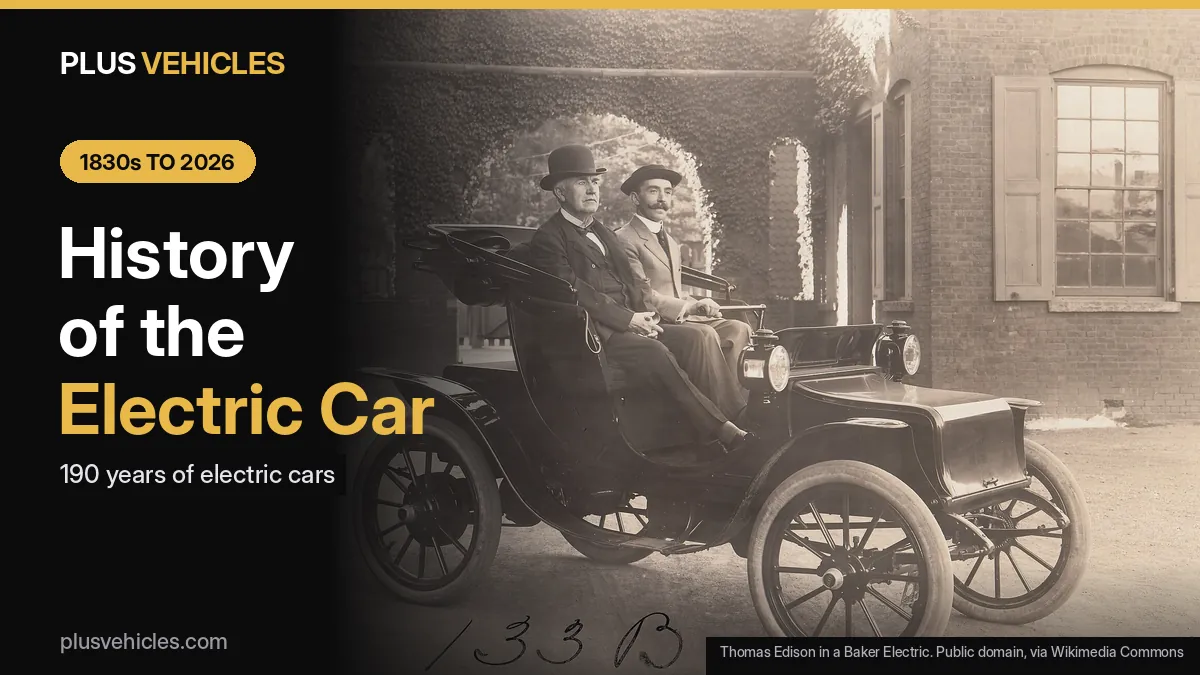
Electric taxis ran in New York and London, and brands such as Columbia, Baker and Detroit Electric sold well. An Idaho National Laboratory history notes that a 1902 Wood’s Phaeton offered about 18 miles of range and a top speed of 14 mph for around $2,000, a lot of money at the time.
There was even an early hybrid. Around 1900, a young Ferdinand Porsche developed the Lohner-Porsche, which used a gasoline engine to generate electricity for wheel-hub motors, roughly a century before the Prius.
Why did electric cars disappear? The decline from around 1910
Electric cars didn’t fail because they were bad. Gasoline cars simply got cheaper, easier and more practical, fast:
- The Ford Model T (1908): Henry Ford’s mass production made gasoline cars dramatically cheaper. The DOE notes that by 1912 a Model T cost around $650, while an electric roadster sold for about $1,750.
- The electric self-starter (1912): Charles Kettering’s starter, first fitted to 1912 Cadillacs, removed the hand crank. Britannica calls it the first death knell of the electric car.
- Cheap oil and better roads: Texas oil discoveries made gasoline cheap and widely available, and new intercity roads favored cars that could travel further than an electric’s 20-50 miles.
- Few homes had electricity: Outside cities, many households couldn’t charge an electric car at all.
By the mid-1930s, electric cars had all but vanished from private roads. They survived in niches, such as British milk floats, golf carts, factory vehicles and, later, NASA’s Lunar Roving Vehicle, which drove on the Moon in 1971.
The 1970s: Oil crises spark a revival
The 1973 Arab oil embargo and the 1979 oil shock sent gasoline prices soaring and caused long lines at fuel stations in the US and Europe. Cars that didn’t need oil looked attractive again.
The US passed the Electric and Hybrid Vehicle Research, Development, and Demonstration Act in 1976, and several small companies built electric cars. The best known was the wedge-shaped Sebring-Vanguard CitiCar, which sold a few thousand units in the mid-1970s, making it one of the best-selling US electric cars of its era.
However, these cars still relied on lead-acid batteries. Typical range was around 40-60 miles and top speeds were low, so when oil prices fell in the 1980s, interest faded once more.
The 1990s: Clean-air rules and the GM EV1
The next push came from regulation. In 1990, the California Air Resources Board (CARB) adopted a Zero Emission Vehicle (ZEV) mandate, requiring large carmakers to make a rising share of their California sales emission-free, starting at 2% by 1998 and rising to 10% by 2003. CARB later relaxed the timetable under industry pressure.
The most famous car of the period was the General Motors EV1, launched in late 1996. It was the first modern electric car designed from the ground up by a major automaker, and it was offered only on lease in California and Arizona. Later versions with nickel-metal hydride batteries could travel more than 100 miles per charge.
Only around 1,100 EV1s were built. When the leases ended, GM took the cars back and crushed most of them in the early 2000s, a decision that inspired the 2006 documentary Who Killed the Electric Car? Toyota, Honda and Ford also built small batches of electric vehicles for the same mandate.
1997-2000s: The Toyota Prius makes hybrids mainstream
While pure electric cars stalled, the hybrid took off. The Toyota Prius went on sale in Japan in December 1997 and was introduced worldwide in 2000, including in the US and Europe. Honda’s Insight reached the US slightly earlier, in late 1999.
The Prius combined a gasoline engine with an electric motor and a small battery that recharged while driving. It wasn’t a plug-in electric car, but it proved drivers would accept electrified powertrains and taught carmakers to manage batteries at scale.
2008-2012: Tesla and lithium-ion change the game
The breakthrough that made today’s electric cars possible was the lithium-ion battery, already proven in laptops and phones. Tesla Motors, founded in 2003, bet that thousands of these small cells could power a desirable car.
The Tesla Roadster, based on a Lotus Elise chassis, began deliveries in 2008. It could travel over 200 miles on a charge, more than double most earlier electric cars, and it was fast. Only about 2,450 were sold, but it made electric cars exciting.
Then in 2012 Tesla launched the Model S, a full-size luxury sedan with up to around 265 miles of EPA-rated range, over-the-air software updates and access to Tesla’s new Supercharger network.
2010s: The Nissan Leaf and the first mass-market electric cars
At the same time, Nissan aimed for the mass market. The Nissan Leaf went on sale in Japan and the US in December 2010 and later in Europe. With around 73 miles of rated range at launch, it was a practical city car and went on to become the world’s best-selling electric car for much of the 2010s. The Chevrolet Volt, a plug-in hybrid, also launched in December 2010.
Incentives helped: US federal tax credits of up to $7,500, big tax breaks in Norway and Chinese subsidies for “new energy vehicles”. Battery prices fell sharply, and models such as the Tesla Model 3 (2017), Hyundai Kona Electric and Volkswagen ID.3 widened choice. Battery durability also proved better than many feared, as our guide to electric car battery lifespan explains.
China’s rise and BYD’s surge
China is the biggest story of the electric car’s recent history. From the late 2000s, Beijing treated electric cars as a strategic industry, backing them with subsidies, easier license plates in big cities, charging investment and a dominant battery supply chain.
The result is dominance. According to the IEA, electric cars made up nearly 55% of all new car sales in China in 2025, and Chinese carmakers supplied around 60% of electric cars sold worldwide. BYD, which started out as a battery maker in 1995, stopped building pure gasoline cars in 2022. In 2025 it sold about 2.25 million battery-electric cars, overtaking Tesla’s roughly 1.64 million deliveries to become the world’s largest seller of fully electric cars for a full year, as reported by Electrek.
Chinese brands such as BYD, MG, Geely and Chery are now expanding across Europe, Southeast Asia, Latin America, the Middle East, Australia and South Asia, including Pakistan and India, often undercutting Western rivals on price.
2025-2026: Where the electric car stands today
The IEA Global EV Outlook 2026 reports that global electric car sales (battery-electric plus plug-in hybrids) grew about 20% in 2025 to more than 20 million, around 25% of all new cars sold. About 5% of the world’s car fleet is now electric.
- China: nearly 55% of new car sales were electric in 2025.
- Europe: about 28% of sales, after growth of more than 30% under tighter EU CO2 rules.
- United States: just under 10%, held back partly by the end of federal tax credits in late 2025.
- Emerging markets: fast growth from a small base in countries such as Vietnam, Thailand, Indonesia, India, Brazil and Turkey.
Early 2026 was bumpier, with the IEA noting a dip in global sales in the first quarter after policy changes in China and the US. Even so, the agency expects around 23 million electric car sales in 2026, close to 30% of the global market.
If you’re weighing up whether to join that shift, our guide on whether you should buy an electric car covers costs, charging and resale, and our list of the best electric car options shows what’s on sale now.
Electric car history: the full timeline
Where historians disagree on dates, we’ve used “around”.
| Year | Milestone | Why it mattered |
|---|---|---|
| Around 1828 | Ányos Jedlik’s small electric motor vehicle model | One of the first electric-motor vehicles |
| Around 1832-1839 | Robert Anderson’s crude electric carriage (Scotland) | Often called the first electric carriage; non-rechargeable batteries |
| 1859 | Gaston Planté invents the lead-acid battery | Made rechargeable electric cars possible |
| Around 1890 | William Morrison’s electric wagon (Iowa) | First successful US electric car |
| Around 1900 | Electric cars reach roughly a third of US cars | First golden age |
| 1908 | Ford Model T launched | Cheap gasoline cars undercut electrics |
| 1912 | Electric self-starter on Cadillac | Removed the hand crank, gasoline’s biggest drawback |
| 1971 | Lunar Roving Vehicle drives on the Moon | Electric drive survives in niches |
| 1973 and 1979 | Oil crises | Renewed interest; CitiCar and other small electric cars |
| 1990 | CARB Zero Emission Vehicle mandate | Forced carmakers to build electric cars |
| 1996 | GM EV1 launched (lease only) | First modern purpose-built electric car from a major automaker |
| 1997 / 2000 | Toyota Prius in Japan, then worldwide | Made hybrids mainstream |
| 2008 | Tesla Roadster deliveries begin | First lithium-ion highway-capable electric car with 200+ miles of range |
| 2010 | Nissan Leaf and Chevrolet Volt launched | First mass-market modern plug-in cars |
| 2012 | Tesla Model S launched | Proved electric cars could be premium and desirable |
| 2022 | BYD stops making pure gasoline cars | Signals China’s all-in strategy |
| 2025 | Over 20 million electric cars sold (about 25% share); BYD outsells Tesla in fully electric cars | Electric cars go mainstream globally |
| 2026 (forecast) | IEA expects about 23 million sales, close to 30% share | Continued growth despite a slower start to the year |
Then vs. now: How much have electric cars improved?
Figures below are approximate and for illustration.
| Feature | Wood’s Phaeton (1902) | Nissan Leaf (2010) | Typical new electric car (2025-2026) |
|---|---|---|---|
| Battery type | Lead-acid | Lithium-ion (24 kWh) | Lithium-ion (often 50-100 kWh) |
| Range | About 18 miles (29 km) | About 73 miles (EPA) | Roughly 200-350+ miles (320-560+ km) |
| Top speed | About 14 mph (23 km/h) | About 90 mph (145 km/h) | Usually 90-155 mph (145-250 km/h) |
| Charging | Hours at a home or garage | Home or around 50 kW DC | Home, plus DC fast charging often 100-350 kW |
Worked example: a modern electric car with 300 miles of range covers in one charge what a 1902 Phaeton would have needed around 16-17 charges to manage. That leap in battery technology is the main reason the electric car has succeeded this time. Running costs have improved too; see how much it costs to charge an electric car.
Books and films on the electric car story
Prices on AmazonPower Play by Tim Higgins
- The inside story of Tesla’s rise
- Award-winning business journalism
- Great companion to this timeline
Insane Mode by Hamish McKenzie
- How Tesla pushed the industry to go electric
- Written by a former Tesla insider
- Easy, fast-paced read
Who Killed the Electric Car?
- The story of the GM EV1 and why it was crushed
- Essential 1990s electric car history
- Watch it after reading our EV1 section
Elon Musk by Walter Isaacson
- The bestselling 2023 biography
- Covers Tesla from the Roadster to today
- Context for the modern electric car era
As an Amazon Associate, Plus Vehicles earns from qualifying purchases. Learn more.
Related: read how the world’s biggest carmaker is catching up in our Toyota electric car guide to the Corolla EV and Toyota’s battery roadmap.
Thinking about owning one today? Our free electric car tools work out your real range, charging cost, road trip stops and savings against a gas car.
Frequently asked questions
Who invented the first electric car?
No single person did. Robert Anderson in Scotland built a crude electric carriage sometime in the 1830s, and William Morrison built the first successful US electric car around 1890. Many inventors in Europe and America contributed.
Were electric cars around before gasoline cars?
Yes. Experimental electric vehicles date to the 1830s, about 50 years before Karl Benz patented his gasoline Motorwagen in 1886. Around 1900, electric cars were more common in the US than gasoline cars.
Why did early electric cars fail?
Cheap mass-produced gasoline cars like the Ford Model T, the 1912 electric starter, low oil prices, longer-distance driving and a lack of home electricity outside cities all pushed electric cars out by the 1930s.
What was the first modern electric car?
The GM EV1 (1996) is usually considered the first modern, purpose-built electric car from a major automaker. The Tesla Roadster (2008) was the first highway-capable car to use lithium-ion battery cells.
What is the best-selling electric car brand today?
BYD sold the most fully electric cars in 2025, about 2.25 million, ahead of Tesla’s roughly 1.64 million.
How many electric cars are sold each year now?
According to the IEA, more than 20 million electric cars were sold worldwide in 2025, about 25% of new car sales, and around 23 million are expected in 2026.
The bottom line
The electric car’s story is one of an early lead, a long eclipse and a dramatic comeback. Electric cars beat gasoline to market, lost out to cheap oil and the Model T, flickered back to life during the oil crises and the EV1 era, and finally broke through with lithium-ion batteries, Tesla, the Nissan Leaf and China’s huge industrial push.
Today roughly one in four new cars sold worldwide is electric. After nearly two centuries, the electric car is finally doing what its 19th-century inventors hoped: becoming the everyday way people get around.