
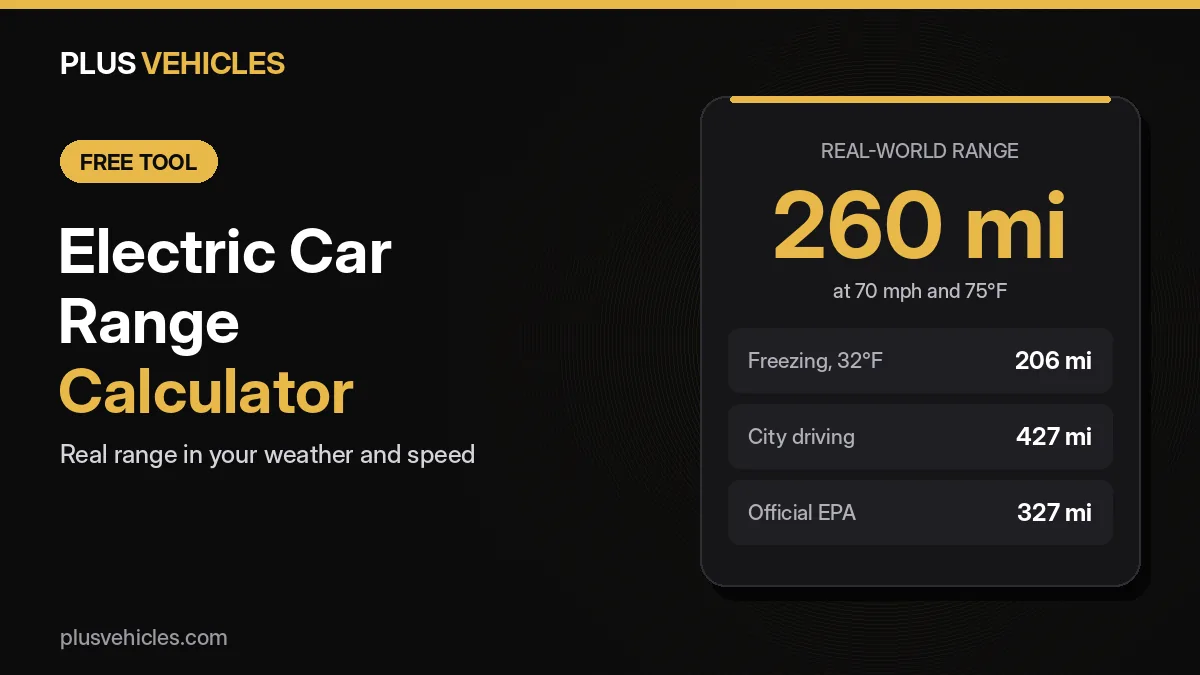
Find out how far your electric car will really go in your weather, at your speed, with the heater or air conditioning on, a full load and an ageing battery.
Where your range goes
Your range by temperature
Estimates based on published cold-weather and speed tests (AAA, Recurrent, Geotab). Your car, tyres and driving style change the result.
Gear that protects your range
Prices on AmazonAstroAI Portable Tire Inflator
- Under-inflated tyres cost range, especially in winter
- Plugs into the 12V socket
- Set the pressure and it stops automatically
Lectron Portable Level 2 Charger
- Charge faster at friends, hotels or a second home
- Works from a NEMA 14-50 outlet
- Keeps a range buffer on winter trips
As an Amazon Associate, Plus Vehicles earns from qualifying purchases. Learn more.
Quick answer: most electric cars reach about 75% to 80% of their official EPA range at a steady 70 mph in mild weather, and about 60% to 65% at 70 mph in freezing weather with the heater on. In slow city traffic they can beat the official figure. Use the electric car range calculator above for your own car and conditions.
Key takeaways
- Speed is the biggest range killer on the highway: going from 55 mph to 75 mph costs about a fifth of your range.
- At freezing (32°F / 0°C) the average electric car keeps about 80% of its range, according to Recurrent data from 18,000 cars; cars with heat pumps keep about 83%.
- AAA measured a 41% range loss at 20°F with the heater on, and 17% at 95°F with air conditioning.
- WLTP ranges (UK and Europe) are about 10% to 20% more optimistic than EPA ranges for the same car.
How to use the electric car range calculator
- Pick your electric car or choose Custom and type the official range from the window sticker or brochure.
- Choose the rating standard. US figures are EPA. UK and European figures are WLTP, which the calculator scales down to an EPA-equivalent first. Chinese CLTC figures are scaled down the most.
- Set the outside temperature, average speed and battery charge. Use your typical highway speed for a trip, or around 30 mph for town driving.
- Choose your heating or air conditioning. Pick “heat pump” if your car has one, or “Eco / seat heat” if you mostly use heated seats and a low cabin temperature.
- Open the extra settings for passengers, a trailer, hills, rain, snow, big wheels and battery health.
The results show your range from the current charge, a “safe to drive” figure that keeps a reserve, a breakdown of where your range goes, and your range at seven different temperatures.
How the range estimate works
The calculator starts from the official range, converts it to an EPA-equivalent, and then applies four effects that published tests keep finding:
- Speed. Air drag rises with the square of speed. Official ranges roughly match steady driving at 50 to 55 mph, so we scale energy use by about 0.76 + 0.0001 × speed² (in mph). At 70 mph that is about 25% more energy per mile; at 80 mph about 40% more.
- Temperature and climate control. A cold battery and a cabin heater both use energy. We use a range-retention curve that matches Recurrent’s finding of about 80% range at freezing and AAA’s 41% loss at 20°F with the heater on. Heat pumps cut the cold-weather loss by about a third. Because heating draws power per hour, the loss is larger at low speeds and smaller on the highway, as Geotab found.
- Load and conditions. Passengers add 1% to 5%, hills up to 10%, rain about 7%, snow about 15%. Towing a trailer roughly halves range or worse.
- Battery health. A battery at 90% health gives 90% of the range. Check yours with our EV battery health calculator.
Formula: real range = official range × rating factor × battery health × temperature factor ÷ (speed factor × load, road and weather factors).
Real-world range of popular electric cars
Estimated full-charge range from our calculator, with the climate control on and standard wheels. “City” is 30 mph stop-and-go at 70°F.
| Electric car | EPA range | 70 mph, 75°F | 70 mph, 32°F | 70 mph, 14°F | City, 70°F |
|---|---|---|---|---|---|
| Tesla Model 3 RWD | 272 mi | 216 mi | 171 mi | 148 mi | 356 mi |
| Tesla Model 3 Long Range AWD | 341 mi | 271 mi | 215 mi | 186 mi | 446 mi |
| Tesla Model Y Long Range AWD (2025+) | 327 mi | 260 mi | 206 mi | 178 mi | 427 mi |
| Chevrolet Equinox EV FWD | 319 mi | 254 mi | 201 mi | 174 mi | 417 mi |
| Ford Mustang Mach-E Extended Range AWD | 300 mi | 238 mi | 189 mi | 163 mi | 392 mi |
| Hyundai Ioniq 5 Long Range RWD (2025) | 318 mi | 253 mi | 200 mi | 173 mi | 416 mi |
| Kia EV6 Long Range RWD (2025) | 319 mi | 254 mi | 201 mi | 174 mi | 417 mi |
| Volkswagen ID.4 Pro RWD | 291 mi | 231 mi | 183 mi | 159 mi | 380 mi |
| Nissan Leaf (40 kWh) | 149 mi | 118 mi | 94 mi | 81 mi | 195 mi |
| Ford F-150 Lightning Extended Range | 320 mi | 254 mi | 202 mi | 174 mi | 418 mi |
Figures are estimates from the model above, not test results for each car. Some cars, especially Teslas with efficient heat pumps, do better in the cold; some early heat pump systems do worse. Choosing a car? See our guide to the best electric car for each type of driver.
How much range do electric cars lose in winter?
Cold weather is the most common reason owners see less range than the sticker. Recurrent’s study of more than 18,000 cars found the average electric car keeps about 80% of its range at or below freezing, with Tesla Model S and X holding 88% to 89% and some models dropping to the low 70s. Cars with a heat pump kept 83% on average, cars without one 75%.
The loss is temporary: range comes back in spring, and cold does not damage the battery. To get more range in winter, precondition the car while it is still plugged in, use heated seats and steering wheel instead of heating the whole cabin, and keep tyres at the right pressure, which drops in the cold.
8 ways to get more range from your electric car
- Drive 5 to 10 mph slower on the highway. It is the single biggest gain.
- Precondition the cabin and battery while plugged in, so the energy comes from the grid, not the battery.
- Use seat and steering wheel heaters; they use a fraction of the power of cabin heating.
- Check tyre pressure monthly; under-inflated tyres can cost 3% to 5% of range.
- Remove roof boxes and bike racks when you do not need them.
- Use the highest regenerative braking setting and anticipate stops.
- Park in a garage in winter so the battery starts warmer.
- For daily driving, charge to 80%; on a trip, charge to what you need. Our EV road trip calculator plans the stops for you.
Frequently asked questions
How far can an electric car go on a full charge?
Most new electric cars are rated at 250 to 350 miles (400 to 560 km) on the EPA test. In real driving, expect about 75% to 80% of that at a steady 70 mph in mild weather, and 60% to 65% at 70 mph in freezing weather.
How do I calculate my electric car’s real range?
Start from the official range, convert WLTP or CLTC figures to EPA-equivalent, then reduce it for your speed, temperature, heating or air conditioning, load and battery health. The electric car range calculator above does this for you and shows where each mile goes.
Why is my EV range lower than advertised?
The official test includes a lot of moderate-speed driving in mild weather. Highway speeds, cold weather with the heater on, hot weather with air conditioning, hills, roof boxes and an ageing battery all lower real-world range.
How much range does an electric car lose in cold weather?
About 20% on average at freezing temperatures, according to Recurrent data from more than 18,000 cars, and up to about 40% at 20°F with the heater running, according to AAA tests. Cars with heat pumps lose less.
Does driving faster reduce electric car range?
Yes, more than in a gas car. Air resistance grows with the square of speed, so driving at 75 mph instead of 60 mph can cut range by about 20%. Slow city driving often gives more range than the official figure.
Is WLTP range the same as EPA range?
No. WLTP figures used in the UK and Europe are usually 10% to 20% higher than the EPA figure for the same car, because the test is gentler. The calculator converts WLTP to an EPA-equivalent before estimating real range.
The bottom line
Official range is a starting point, not a promise. Speed and cold weather do most of the damage, and both are predictable. Put your own car, speed and weather into the electric car range calculator above before a long trip or a winter commute, and plan with the “safe to drive” figure.