
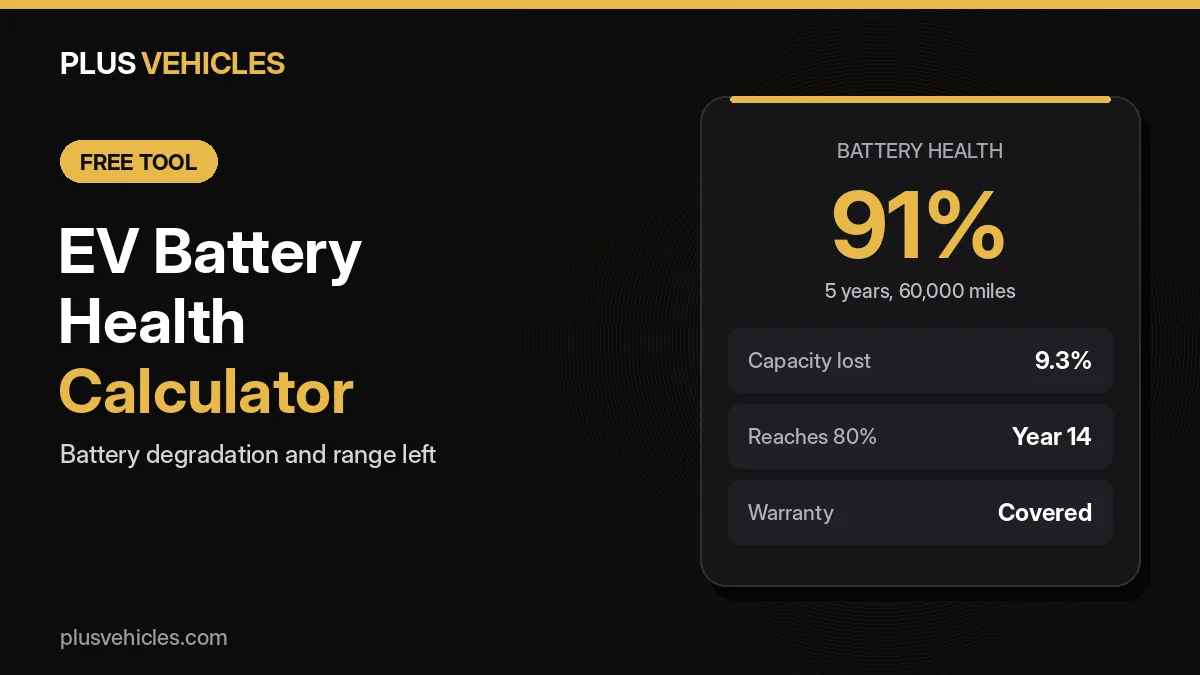
Estimate how much battery capacity an electric car has lost, how much range is left, when it will reach 80% and whether the battery warranty is likely to matter.
Battery health over time
Estimate based on large fleet studies (Geotab, Recurrent). Only a battery health report from the car or a dealer shows the real number.
Check your battery yourself
Prices on AmazonVeepeak OBDCheck BLE+ OBD2 Scanner
- Bluetooth reader for apps like Car Scanner and Leaf Spy
- Shows state of health and cell data on many EVs
- Check a used electric car before you buy
Grizzl-E Classic 40A
- AC charging is kinder to the battery than fast charging
- Simple, tough and UL certified
- Rated for indoor and outdoor use
As an Amazon Associate, Plus Vehicles earns from qualifying purchases. Learn more.
Quick answer: the average electric car battery loses about 2.3% of its capacity per year (Geotab, 22,700 vehicles), so a typical 5-year-old electric car has about 88% to 92% battery health and an 8-year-old one about 82% to 88%. Hot climates, frequent DC fast charging and air-cooled batteries such as the Nissan Leaf’s wear faster. The EV battery health calculator above estimates it for your car.
Key takeaways
- Most batteries lose a few percent in the first year or two, then degrade slowly and steadily.
- Geotab found DC fast charging above 100 kW can double degradation, to up to 3% a year, against about 1.5% for cars charged mainly on AC.
- LFP batteries usually age more slowly and are happy to charge to 100%.
- Most warranties cover the battery for 8 years or 100,000 miles (160,000 km) against falling below about 70%.
How to use the EV battery health calculator
- Choose the battery type. Most electric cars use liquid-cooled NMC or NCA cells. Tesla RWD models, BYD and many Chinese cars use LFP. The Nissan Leaf and some early cars use air cooling.
- Enter the age, odometer reading and official range when new.
- Choose the climate, how often the car fast charges and its usual charge limit. For a used car, ask the seller or check the charging history in the app.
- Optional: enter a battery health figure from a report, app or dealer check to see whether it is better or worse than typical, and set the warranty terms.
You get an estimated state of health (SOH) with a typical range, the range left, capacity lost per year, when the battery will reach 80%, a warranty check and a chart of battery health over time.
How battery degradation is estimated
Battery wear has two parts. Calendar ageing happens with time, faster when the battery is hot or sits at a high charge. Cycle ageing comes from charging and driving, faster with frequent DC fast charging. The calculator adds both:
Capacity lost = early drop (about 3.5% over the first two years) + about 0.9% per year + about 0.7% per 100 full charge cycles, for a liquid-cooled NMC battery in a mild climate. Full cycles = distance ÷ official range.
Each factor is then adjusted: hot climates add about 40% to calendar ageing, frequent fast charging up to 50% to calendar and 100% to cycle ageing, charging to 100% every day about 15% for NMC batteries. LFP batteries age about a third slower; air-cooled batteries about twice as fast. The figures are calibrated to Geotab’s fleet study (average 2.3% a year, 81.6% after 8 years across its whole sample, about 1.5% a year for AC-charged cars).
Typical battery health by age and use
| Battery | Age / miles | Climate | Fast charging, limit | Estimated health | Typical range |
|---|---|---|---|---|---|
| NMC, liquid-cooled | 2 yrs / 24,000 mi | mild | rarely, 90% | 95% | 92–98% |
| NMC, liquid-cooled | 5 yrs / 60,000 mi | mild | rarely, 90% | 91% | 87–95% |
| NMC, liquid-cooled | 8 yrs / 96,000 mi | mild | rarely, 90% | 87% | 82–92% |
| NMC, liquid-cooled | 8 yrs / 96,000 mi | hot | mostly, 100% | 69% | 60–78% |
| NMC, liquid-cooled | 10 yrs / 120,000 mi | mild | rarely, 80% | 85% | 80–90% |
| LFP | 5 yrs / 60,000 mi | mild | rarely, 100% | 94% | 91–97% |
| LFP | 8 yrs / 96,000 mi | hot | sometimes, 100% | 87% | 82–92% |
| Air-cooled (Leaf) | 5 yrs / 50,000 mi | mild | rarely, 90% | 83% | 77–89% |
| Air-cooled (Leaf) | 5 yrs / 50,000 mi | hot | rarely, 100% | 71% | 63–80% |
Battery health only tells part of the story. A battery at 85% on a car rated for 300 miles still gives about 255 miles, which is more than most new electric cars offered a few years ago. Read more in our guide to electric car battery lifespan.
How to check the real battery health of an electric car
- In the car: some models show battery health or the full-charge range in a service menu. Tesla shows a battery test in Service mode on newer software.
- With an OBD2 reader and app: apps such as Car Scanner, Leaf Spy (Nissan) or Scan My Tesla read the state of health from the battery management system.
- Battery reports: services such as Recurrent and several dealers and used-car sites provide a battery report for a vehicle.
- Range test: charge to 100%, note the estimated range, and compare it with the official range when new. This is rough, because the estimate depends on recent driving.
Then enter the figure above to see whether it is normal for the car’s age and mileage.
How to slow down battery degradation
- Charge to 80% or 90% for daily driving if your car has an NMC battery; LFP batteries are fine at 100%.
- Use AC charging at home and save DC fast charging for trips.
- Avoid leaving the car at 100% or near 0% for days at a time.
- Park in the shade or a garage in very hot weather.
- Keep the software up to date; manufacturers improve battery management over time.
Frequently asked questions
How much battery degradation is normal for an electric car?
About 2% a year on average, according to Geotab data from more than 22,700 vehicles. A healthy 5-year-old electric car usually has 88% to 92% of its original capacity, and an 8-year-old one 82% to 88%.
How long do electric car batteries last?
Most electric car batteries are expected to last the life of the car, 15 to 20 years or more. At typical degradation rates a battery still has about 75% to 80% of its capacity after 12 to 15 years.
Does fast charging damage an electric car battery?
Frequent DC fast charging speeds up wear. Geotab found cars that fast charge above 100 kW most of the time degrade at up to 3% a year, against about 1.5% for cars charged mainly on AC. Occasional fast charging on trips makes little difference.
Is it bad to charge an electric car to 100%?
For NMC and NCA batteries, sitting at 100% every day speeds up ageing slightly, so most makers recommend 80% to 90% for daily use and 100% before a long trip. LFP batteries can and should be charged to 100% regularly.
What battery health should I look for in a used electric car?
Compare it with what is normal for the car’s age and mileage using the calculator above. As a guide, above 90% is good for a car under 5 years old and above 85% is good for a car of 5 to 8 years. Anything well below typical is worth a closer check.
What does an EV battery warranty cover?
Most manufacturers cover the battery for 8 years or 100,000 miles (some 160,000 km or more) and will repair or replace it if capacity falls below about 70%. Check the exact terms for your car, as some brands use 60% or 75%.
The bottom line
Electric car batteries wear out far more slowly than most people expect, and the warranty covers the rare battery that fails early. Use the EV battery health calculator above to see what is normal for your car, and get a proper battery report before you buy a used electric car.