
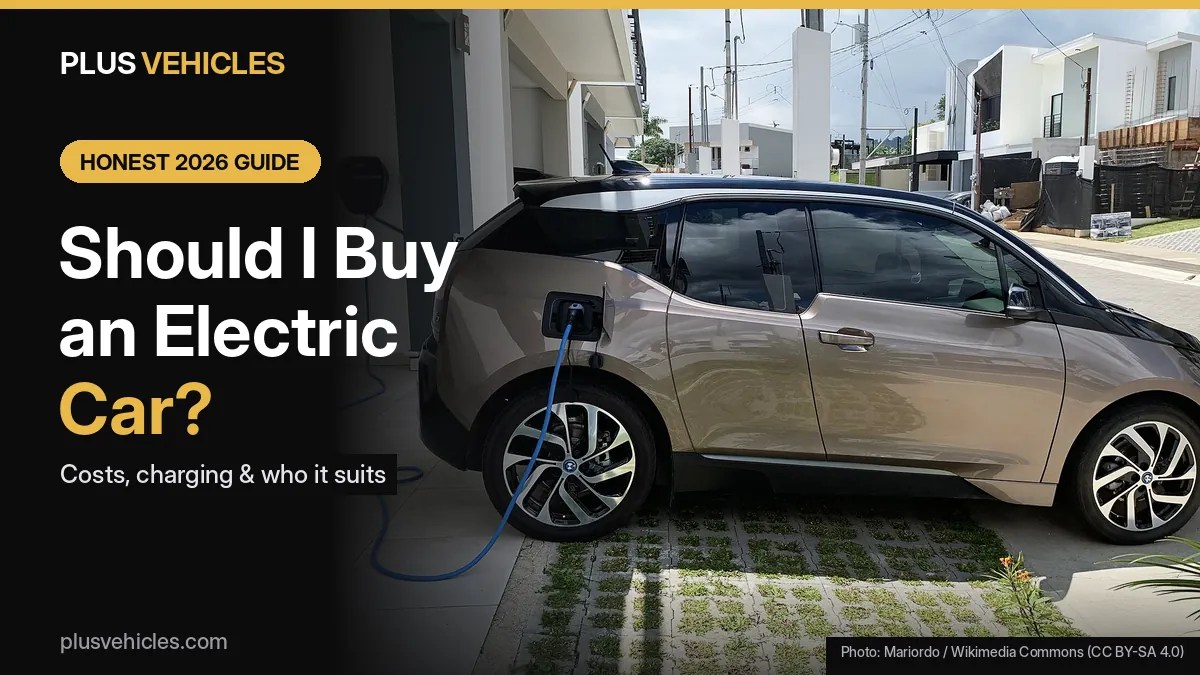
This post contains affiliate links. If you buy through them we may earn a commission at no extra cost to you.
Last updated: October 22, 2026
Should I buy an electric car? For most people who can charge at home, drive a predictable amount each day and plan to keep the car for several years, the answer in 2026 is yes: an electric car usually costs far less to fuel and maintain, and it is quieter and quicker than a comparable gas car. If you cannot charge at home, drive very long distances in a cold climate, or need the cheapest possible car this year, waiting or choosing a hybrid may be the smarter move.
This guide covers the real pros and cons, a total cost of ownership comparison, a decision checklist, and an up-to-date look at incentives in the US, UK, Europe, India, Pakistan and Australia as of October 2026.
Key takeaways
- Home charging is the single biggest factor. With it, an electric car is cheap and convenient; without it, the math and the hassle both get worse.
- Energy costs are much lower: AAA puts electric car charging costs about 66% to 70% below gasoline fuel costs in its 2026 study.
- Depreciation is the catch. AAA found a new midsize electric sedan costs about 29% more per year to own than its gas equivalent, mostly because it loses value faster.
- The US federal $7,500 new and $4,000 used electric car tax credits ended for vehicles acquired after September 30, 2025. They are not available in 2026.
- Used electric cars and leases are often the best value, because someone else has absorbed the steepest depreciation.
- Battery failure is rare in modern cars: Recurrent data shows about 0.3% of 2022-and-newer electric cars have needed a battery replacement outside recalls.
In this article
- Is an electric car right for you?
- The pros of buying an electric car
- The cons of buying an electric car
- Total cost of ownership: electric vs gasoline
- Your decision checklist
- Electric car incentives by region (as of October 2026)
- New vs used electric cars
- Should you lease an electric car instead?
- Who should wait before buying an electric car?
- Frequently asked questions
- The bottom line
Is an electric car right for you?
The real question is fit, not technology. Electric cars are now mature, reliable and available in almost every size class. Whether one makes sense for you comes down to five things: where you park overnight, how far you drive, your climate, your budget, and what incentives exist where you live.
If you tick most of the boxes in the checklist below, an electric car is very likely to save you money over five or more years and make daily driving more pleasant. If you tick only one or two, a hybrid or a carefully chosen used electric car may serve you better for now.
The pros of buying an electric car
Much cheaper “fuel”
Electricity costs less per mile than gasoline almost everywhere, especially if you charge at home on an off-peak tariff. In its 2026 Your Driving Costs study, AAA assumed gas at about $4.15 per gallon and home electricity at 18 cents per kWh, and found electric car charging costs roughly 66% to 70% lower than fueling a gas car. For a detailed breakdown by country, see our guide on how much it costs to charge an electric car.
Lower maintenance
An electric motor has far fewer moving parts than an engine: no oil changes, spark plugs, timing belts or exhaust systems, and regenerative braking means brake pads last longer. Consumer Reports found electric car owners spend about half as much on maintenance and repairs as gas car owners, roughly 3 cents per mile versus 6 cents.
A better daily driving experience
Instant torque makes even affordable electric cars feel quick in traffic. They are quiet and smooth, and you leave home with a “full tank” every morning if you charge overnight.
Batteries are lasting longer than feared
Battery anxiety is fading as real-world data piles up. According to Recurrent, only about 0.3% of 2022-and-newer electric cars have needed a battery replacement (excluding recalls), and most cars carry a battery warranty of around 8 years or 100,000 miles. Read more in our guide to electric car battery lifespan.
Zero tailpipe emissions
Electric cars produce no exhaust at street level, and their lifetime emissions are generally lower than a comparable gas car.
The cons of buying an electric car
Higher upfront price and faster depreciation
New electric cars still tend to cost more than comparable gas models, and in the US they now do so without the federal tax credit. They have also been losing value faster. AAA reports that depreciation, plus higher fees and financing costs, often outweighs the fuel savings, leaving a new midsize electric sedan about 29% more expensive to own each year than its gas counterpart.
Charging without a driveway is harder
If you live in an apartment or rely on street parking, you will depend on public chargers. Rapid charging is convenient on road trips but can cost several times more per kWh than home charging, which erodes much of the running-cost advantage.
Cold weather cuts range
A 2026 AAA study found that at 20°F (-7°C), electric cars lost an average of 39% of their driving range with the cabin heater running, compared with about 8.5% at 95°F (35°C). Heat pumps and battery preconditioning help, but if you face long winter commutes, size the battery generously.
Road trips need a little planning
Fast-charging coverage and reliability vary by country and route. Expect stops of roughly 20 to 40 minutes on long journeys, depending on the car.
Insurance, tires and taxes
Electric cars are heavier, so tires can wear faster, and insurance premiums are often higher because repairs can be costly. Governments are also starting to recover lost fuel-tax revenue: many US states charge extra annual registration fees for electric cars, and the UK has confirmed a 3p-per-mile charge on electric cars from April 2028, on top of standard road tax.
Total cost of ownership: electric vs gasoline
Here is a simplified five-year comparison for a mid-size car driven 15,000 miles a year, using AAA’s 2026 fuel and electricity assumptions and Consumer Reports maintenance figures. Treat it as a worked example, not a quote: your numbers will depend on local prices and the exact models.
| Cost item (5 years, 75,000 miles) | Electric car | Gasoline car | Notes |
|---|---|---|---|
| Energy | About $4,250 | About $10,400 | EV at 3.5 miles/kWh, 18¢/kWh plus ~10% charging losses; gas car at 30 mpg, $4.15/gal |
| Maintenance and repairs | About $2,250 | About $4,500 | Consumer Reports: ~3¢ vs ~6¢ per mile |
| Purchase price | Usually higher | Usually lower | Gap varies widely by model; no US federal credit in 2026 |
| Depreciation | Usually higher | Usually lower | The biggest swing factor, per AAA |
| Insurance | Often higher | Often lower | Get quotes for the exact models before buying |
| Taxes and fees | Extra EV fees in many US states | Standard fees; fuel taxes paid at the pump | UK adds 3p/mile eVED from April 2028 |
In this example, the electric car saves roughly $8,400 over five years in energy and maintenance. If the electric car costs $5,000 more up front and loses an extra few thousand dollars in value, the advantage shrinks or disappears, which is exactly what AAA found for some new midsize sedans. Buy a used electric car, or a new one with a smaller price premium, and the savings come back into view.
If you rely on public rapid charging, your energy cost can approach that of a gas car. If you drive more than average, every extra mile widens the electric car’s lead.
Your decision checklist
Answer these seven questions. The more times you say “yes”, the stronger the case for going electric.
- Home charging access: Can you charge where you park overnight, either with a wall charger or even a regular outlet? Workplace charging counts too. This is the most important box to tick.
- Daily driving: Is your typical day under about 150 miles (240 km)? Most electric cars cover that comfortably, even in winter, with plenty to spare.
- Long trips: Are long drives occasional, and is there reliable fast charging on your usual routes? If you regularly tow or cross remote regions, check carefully.
- Climate: If winters regularly fall well below freezing, can you accept a 30% to 40% range drop on the coldest days? Look for a car with a heat pump.
- Budget: Can you afford the purchase or lease without stretching, and do you plan to keep the car at least five years so running-cost savings add up?
- Incentives: Have you checked current national, state or regional incentives, utility rebates, and tax treatment where you live? (See the next section.)
- Electricity prices: Is your home electricity reasonably priced, ideally with a cheaper overnight rate or rooftop solar?
Set up home charging the right way
Prices on AmazonChargePoint Home Flex
- Adjustable 16 to 50 amps to suit your panel
- App tracks energy use and charging cost
- Plug-in or hardwired install
Emporia Level 2 Smart EV Charger
- Up to 48 amps for fast overnight charging
- Schedules charging for cheap off-peak hours
- Energy Star certified
Grizzl-E Classic 40A
- Cast aluminium case for outdoor driveways
- Simple plug-and-charge, no app needed
- UL certified, rated for indoor and outdoor use
Emporia Vue Smart Energy Monitor
- Shows exactly how many kWh your car uses
- See the real cost of every charge
- Spots costly peak-hour charging
As an Amazon Associate, Plus Vehicles earns from qualifying purchases. Learn more.
Electric car incentives by region (as of October 2026)
Incentives change often. Always confirm with the official source before you sign anything.
| Region | Main incentive status in 2026 | What to check |
|---|---|---|
| United States | Federal new ($7,500), used ($4,000) and commercial clean vehicle credits ended for vehicles acquired after Sept 30, 2025. The home charger credit (30C) ended for equipment placed in service after June 30, 2026. | State rebates, utility rebates and EV registration fees, which vary by state |
| United Kingdom | Electric Car Grant: £3,750 or £1,500 off eligible new cars priced up to £37,000, applied by the dealer. Company car (BIK) tax is 4% in 2026/27, rising to 5% in 2027/28. | Which models and trims qualify; the 3p/mile eVED from April 2028 |
| Germany | New income-based subsidy for private buyers of cars first registered from January 1, 2026: roughly €1,500 to €6,000 depending on income, children and powertrain. Leasing is covered. | Household income limits and the three-year holding rule |
| India | Electric cars pay 5% GST, versus 18% for small and 40% for larger petrol and diesel cars after the September 2025 GST reform. Road tax relief depends on the state. | Your state’s current road tax and registration rules |
| Pakistan | Reduced sales-tax rates apply to some locally assembled and imported small electric cars, and Sindh has extended provincial EV incentives to 2028. The 2026-31 auto policy was still being negotiated with the IMF. | Final federal policy and your province’s registration rules |
| Australia | Full fringe benefits tax (FBT) exemption for eligible electric cars via employer novated leases continues until March 31, 2027, then is phased down. Plug-in hybrids lost eligibility for new arrangements from April 2025. | The value thresholds that apply from April 2027; state and territory schemes |
US readers should note that some articles still describe the $7,500 credit as available. It is not: the IRS confirms the new, used and commercial clean vehicle credits do not apply to vehicles acquired after September 30, 2025, and the home charger credit also closed on June 30, 2026. The only exception is a buyer who signed a binding contract and made a payment by September 30, 2025.
In the UK, the Electric Car Grant is applied automatically at the dealership, so check whether the exact trim you want is on the eligible list. In Australia, the ATO’s electric car FBT exemption makes novated leasing especially attractive until the phase-down begins in April 2027.
New vs used electric cars
Because electric cars depreciate quickly, the used market is where bargains are. Recurrent reported that nearly 18% of used electric car sales in early 2026 were under $25,000, and several popular models from 2021 onward are now priced close to comparable gas cars.
| New electric car | Used electric car | |
|---|---|---|
| Price | Higher; full depreciation hit is yours | Lower; previous owner absorbed the steepest drop |
| Technology | Latest range, charging speed and software | May have slower charging or older battery chemistry |
| Warranty | Full battery warranty (often 8 years/100,000 miles) | Remaining battery warranty usually transfers; check the dates |
| Incentives | UK grant and German subsidy apply to new cars | Few incentives in 2026; the US used credit has ended |
| Best for | Buyers who want the newest tech and keep cars long | Value seekers and second-car households |
When buying used, ask for a battery health report (state of health), confirm which charging connector the car uses, and check that the remaining battery warranty covers your expected ownership period. Not sure which model to shortlist? Our guide to the best electric car for different budgets is a good starting point.
Should you lease an electric car instead?
Leasing makes a lot of sense for electric cars right now. Technology and prices are moving quickly, and a lease shifts the depreciation risk to the finance company: if the car is worth less than expected at the end, that is their problem, not yours.
- Lease if you want a new electric car but worry about resale value, you like changing cars every two to four years, or your employer offers a tax-efficient scheme such as UK salary sacrifice or an Australian novated lease.
- Buy if you drive a lot of miles (lease mileage caps can be costly), you keep cars for many years, or you have found a good-value used electric car.
In the US, leases were once the easiest way to capture the $7,500 commercial credit. With that credit gone, compare lease offers carefully; some manufacturers still subsidize leases with their own discounts.
Who should wait before buying an electric car?
An electric car is not the right choice for everyone yet. Consider waiting, or choosing a hybrid, if you:
- Have no reliable place to charge at home or work and limited public charging nearby.
- Regularly drive long distances in very cold weather or through areas with sparse fast charging.
- Tow heavy loads often, since towing can cut range by roughly half.
- Plan to sell within two or three years and are buying new, which exposes you to the steepest depreciation.
- Are counting on an incentive that has ended (like the US federal credit) or one that is about to change, such as Australia’s FBT exemption from April 2027.
Waiting is not a bad option: ranges keep rising and charging networks keep expanding. Our history of the electric car shows how quickly things have moved.
Related: if you are torn between waiting and buying, our Toyota electric car guide covers the Corolla EV timeline and the 2027 bZ prices.
Run your own numbers: the electric car vs gas cost calculator shows your break-even year, the electric car range calculator checks real range in your weather, and the EV road trip calculator plans charging stops for your longest drive.
Frequently asked questions
Is it worth buying an electric car in 2026?
Yes, if you can charge at home and keep the car for five years or more. Energy and maintenance savings typically add up to several thousand dollars over that time. Without home charging, or if you sell quickly, the case is weaker.
Is the $7,500 federal EV tax credit still available?
No. The US new clean vehicle credit, the used credit and the commercial credit ended for vehicles acquired after September 30, 2025. Some states and utilities still offer their own rebates.
How long do electric car batteries last?
Most modern batteries are expected to outlast the typical ownership period, and replacements are rare. Most automakers warranty the battery for around 8 years or 100,000 miles.
Can I own an electric car without home charging?
Yes, using workplace or public charging, but it is less convenient and usually more expensive.
Is a hybrid a better choice than an electric car?
For drivers who cannot charge at home or who sell cars quickly, a hybrid can be cheaper overall. AAA’s 2026 study found hybrids had the lowest annual ownership cost in several vehicle classes.
Are electric cars expensive to insure?
Premiums are often higher than for comparable gas cars because repairs can cost more, so get quotes before you commit.
The bottom line
If you have somewhere to charge overnight, a predictable daily drive and a budget that lets you keep the car for a while, buying an electric car in 2026 is a smart, enjoyable choice, especially used or on a lease. If home charging is out of reach or the numbers only work with an incentive that has disappeared, a hybrid or a little patience is perfectly reasonable. Run the checklist and let your own numbers decide.