
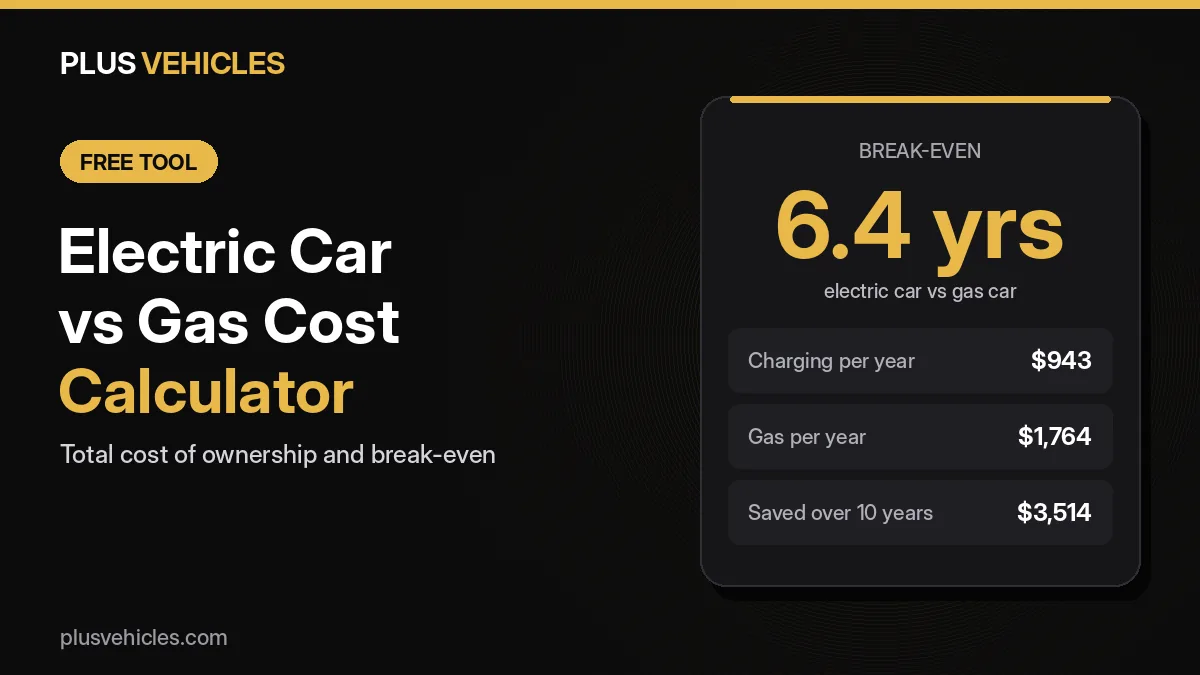
Compare the full cost of owning an electric car and a gas car: price, incentives, charging vs fuel, maintenance, insurance and resale value, year by year.
Where the money goes
Running total, year by year
Default prices are typical 2026 examples. Replace them with real quotes for the two cars you are comparing.
Cut the running cost of an electric car
Prices on AmazonChargePoint Home Flex
- Charges up to 50 amps at home
- Schedules charging for cheap off-peak hours
- Tracks what each charge costs
Grizzl-E Classic 40A
- Simple plug-and-charge, no app needed
- Rated for indoor and outdoor use
- UL certified
Emporia Vue Energy Monitor
- See the real kWh your car uses at home
- Spot the cheapest hours to charge
- Fits in your breaker panel
As an Amazon Associate, Plus Vehicles earns from qualifying purchases. Learn more.
Quick answer: an electric car usually costs more to buy but less to run. With typical 2026 prices, home charging saves about $800 a year on fuel in the US and maintenance costs about $450 a year less, so a comparable electric car usually breaks even after about 5 to 8 years. Keep it longer, charge at home and drive more, and the electric car wins; rely on fast charging or sell after 3 years, and the gas car often does. Put your own two cars into the calculator above.
Key takeaways
- Fuel savings are the biggest advantage: charging at home costs roughly half as much per mile as gas in most countries.
- Depreciation is the biggest cost for both cars, and electric cars have lost value faster than gas cars in recent years.
- Insurance is often 5% to 20% higher for an electric car, which eats into the savings.
- The US federal $7,500 tax credit ended for cars bought after September 30, 2025, so check state and utility rebates instead.
How to use the electric car vs gas cost calculator
- Choose your country to load typical prices for electricity, fuel, insurance and maintenance in the US, UK, Canada, Germany, Australia, UAE, Pakistan or India.
- Enter the two cars you are comparing. The defaults are typical examples; replace them with real quotes, including any rebate or dealer discount.
- Set your yearly distance and how long you will keep the car. Resale value adjusts automatically with the number of years.
- Tell it where you charge. The share charged at home matters a lot: public fast charging can cost 2 to 4 times the home rate.
- Open the extra settings for maintenance, insurance, resale value, a home charger installation, yearly tax and energy price rises.
You get the total cost of each car after resale, the cost per mile or km, the break-even point, a breakdown of where the money goes and a year-by-year running total.
How total cost of ownership is calculated
Total cost = purchase price − incentives + home charger + (energy + maintenance + insurance + tax) × years − resale value.
Energy for the electric car = yearly distance × kWh per 100 miles ÷ 100 × (home share × home price ÷ 0.9 + public share × public price ÷ 0.95), which includes about 10% charging losses at home. Fuel for the gas car = yearly distance ÷ mpg × price per gallon (or litres per 100 km × price per litre). Energy prices rise by the percentage you set each year.
The break-even point compares cash spent before you sell: the year when the electric car’s lower running costs have paid back its higher purchase price.
Electric car vs gas: results by country
Results from the calculator with its default example cars and prices for each country, charging 80% at home. Your result depends on the exact cars you compare.
| Country | Charging vs fuel, year 1 | Over 5 years | Over 10 years | Break-even |
|---|---|---|---|---|
| United States | $943 vs $1,764 | Gas saves $576 | EV saves $3,514 | 6.4 years |
| United Kingdom | £541 vs £1,248 | Gas saves £2,006 | EV saves £1,001 | 8.1 years |
| Canada | C$747 vs C$2,108 | Gas saves C$2,419 | EV saves C$5,098 | 6.6 years |
| Germany | €1,119 vs €1,938 | Gas saves €1,457 | EV saves €3,929 | 4.9 years |
| Australia | A$982 vs A$2,548 | Gas saves A$1,850 | EV saves A$6,347 | 6.2 years |
| UAE | AED 1,813 vs AED 6,848 | Gas saves AED 4,299 | EV saves AED 21,428 | 5.9 years |
| Pakistan | Rs 125,025 vs Rs 335,569 | Gas saves Rs 1,704,320 | Gas saves Rs 1,084,600 | 13.8 years |
| India | ₹20,379 vs ₹82,104 | Gas saves ₹28,778 | EV saves ₹244,877 | 5.9 years |
The pattern is the same almost everywhere: the electric car loses a little over a short ownership and wins clearly over a long one. Pakistan is the exception with these defaults, because imported electric cars still cost far more than locally built petrol cars. For the full picture beyond money, read should I buy an electric car.
What decides whether an electric car is cheaper?
- Where you charge. Home charging, especially on an off-peak tariff, is what makes electric cars cheap to run. Check your real rate with our EV charging cost calculator.
- How far you drive. The more miles, the faster the fuel savings pay back the higher price.
- How long you keep the car. Depreciation is heaviest in the first three years.
- The price gap. Compare like with like: an electric SUV against the gas version of a similar SUV, after rebates and discounts.
- Fuel prices. Every $1 per gallon added to gas saves a 12,000-mile driver about $400 a year with an electric car.
Electric car incentives in 2026
In the US, the federal clean vehicle credits (up to $7,500 new, $4,000 used) ended for vehicles acquired after September 30, 2025. Many states and utilities still offer rebates on cars and home chargers, so add those in the incentives box. In the UK, the Electric Car Grant offers up to £3,750 off eligible new cars. Other countries offer lower registration fees, tax breaks or free charging; enter them as incentives or as lower yearly tax.
Frequently asked questions
Is an electric car cheaper than a gas car over 5 years?
It is close. With typical 2026 prices the totals are usually within a few thousand dollars over 5 years, and the electric car pulls ahead after about 5 to 8 years. Charging at home and driving more than average tip it towards the electric car.
How much do you save on fuel with an electric car?
In the US, a typical electric SUV costs about $940 a year to charge, mostly at home, against about $1,760 a year in gas for a 30 mpg car at $4.41 a gallon, a saving of about $800 a year at 12,000 miles.
Are electric cars cheaper to maintain?
Yes. There are no oil changes, spark plugs or exhaust repairs, and brakes last longer thanks to regenerative braking. Consumer Reports found electric car owners spend about half as much on repairs and maintenance as gas car owners; tyres can wear a little faster because electric cars are heavier.
Do electric cars depreciate faster?
In recent years, yes. Falling new-car prices, fast-changing technology and worries about battery life have pushed used electric car values down faster than gas cars, which is why resale value matters so much in this comparison.
Is insurance more expensive for electric cars?
Usually a little. Electric cars cost more to buy and repair, so premiums are often 5% to 20% higher. Get a real quote for both cars and enter it in the calculator.
What is the break-even point for an electric car?
It is the point where the money you save on fuel and maintenance has covered the higher purchase price. With the default examples it is about 5 to 8 years, but it can be day one if the electric car costs the same or less up front.
The bottom line
Electric cars cost more up front and less every month after that. Whether that adds up for you depends on four numbers: the price gap, where you charge, how far you drive and how long you keep the car. Plug in real quotes for your two cars above and you will know exactly which one is cheaper for you.