
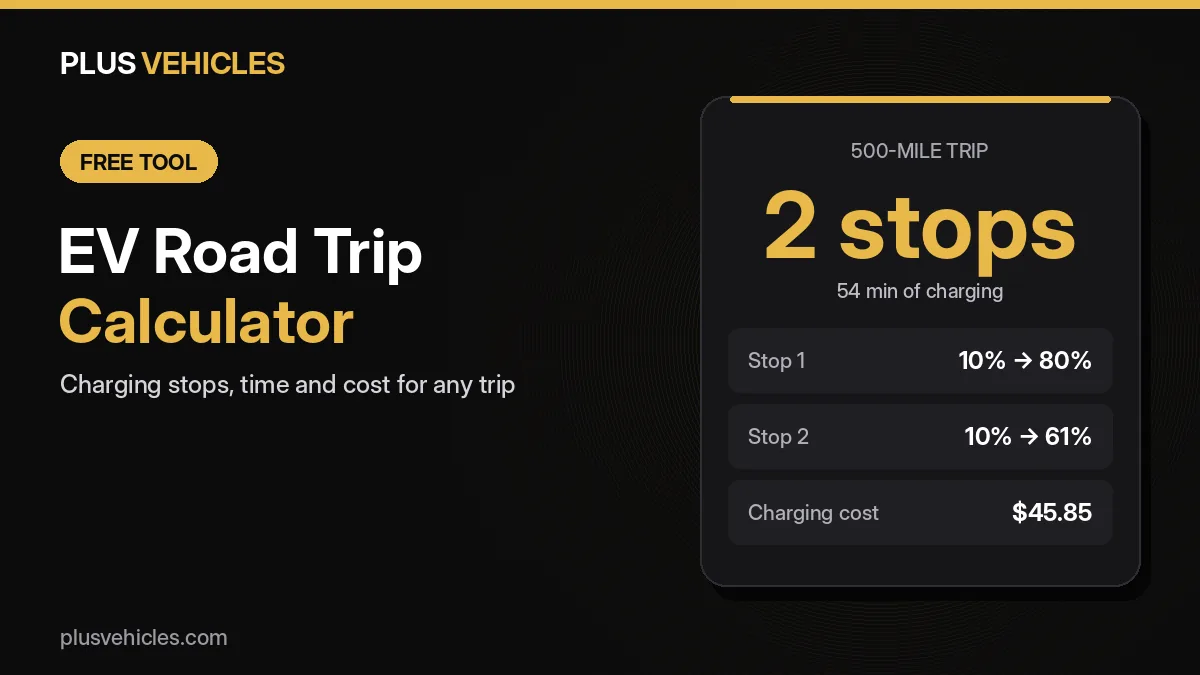
Plan an electric car road trip: how many charging stops you need, how long you will spend charging, where to stop and what the trip will cost compared with a gas car.
Your charging plan
Charging times use typical 10–80% fast-charging tests and slow down above 80%. Check live charger locations in your car’s navigation or a charging app.
Road trip essentials for electric car drivers
Prices on AmazonLectron Tesla to J1772 Adapter
- Lets non-Tesla cars use Tesla destination chargers
- Opens up thousands more hotel chargers
- Small enough for the glovebox
Lectron Portable Level 2 Charger
- Charge overnight from a NEMA 14-50 outlet
- Useful at campsites and holiday homes
- Much faster than a standard plug
AstroAI Portable Tire Inflator
- Correct tyre pressure saves range on long trips
- Runs from the 12V socket
- Auto shut-off at your set pressure
As an Amazon Associate, Plus Vehicles earns from qualifying purchases. Learn more.
Quick answer: a modern electric car with 250 to 300 miles of real highway range usually needs one fast-charging stop every 150 to 200 miles after the first leg, with each stop taking 20 to 40 minutes. A 500-mile trip typically means 2 stops and under an hour and a half of charging in summer, a little more in winter. The EV road trip calculator above works it out for your car, speed and weather.
Key takeaways
- Charge from about 10% to 80% on a trip: charging slows down sharply above 80%.
- Your first leg is the longest, because you leave home with a full battery.
- Highway speed and cold weather change the number of stops more than anything else.
- Fast charging costs 2 to 4 times home electricity, so a road trip can cost about as much as gas.
How to use the EV road trip calculator
- Pick your electric car to load its usable battery, efficiency and typical 10–80% fast-charging time.
- Enter the trip distance and choose one way or round trip.
- Set your starting charge, the level you charge up to, your highway speed and the temperature.
- Open the extra settings to set the charger power, minimum arrival charge, minutes lost per stop, fast-charging price and a gas car for comparison.
The calculator builds a stop-by-stop plan. At the last stop it charges only as much as you need to reach your destination with your chosen reserve, which is how experienced drivers save time.
How the charging stops and times are calculated
Energy use starts from the car’s efficiency at about 55 mph and rises with speed (about 25% more at 70 mph) and with cold weather and heating, using the same model as our electric car range calculator.
Charging time uses each car’s typical 10–80% fast-charging time and a charging curve that runs at full power to about 50%, tapers to half power by 80% and slows to a trickle near 100%. If you pick a charger slower than your car can take, the time stretches accordingly.
Stops = how many times the battery drops to your minimum before the destination. Each stop charges to your chosen level, except the last, which adds just enough to arrive with your reserve.
How many charging stops for a 500-mile trip?
Calculator results for a 500-mile (805 km) one-way trip at 70 mph, leaving with 90%, charging from 10% to 80% on chargers fast enough for each car, 5 minutes lost per stop and 48¢ per kWh. The last column shows stops and charging time at 28°F (-2°C).
| Electric car | Stops | Charging time | Total trip time | Charging cost | Winter: stops / time |
|---|---|---|---|---|---|
| Tesla Model 3 RWD | 3 | 1 h 11 min | 8 h 19 min | $46.19 | 4 / 1 h 41 min |
| Tesla Model Y Long Range AWD (2025+) | 2 | 54 min | 8 h 3 min | $45.85 | 3 / 1 h 22 min |
| Chevrolet Equinox EV FWD | 2 | 1 h 15 min | 8 h 23 min | $53.68 | 3 / 1 h 52 min |
| Ford Mustang Mach-E Extended Range AWD | 2 | 1 h 19 min | 8 h 27 min | $62.53 | 3 / 1 h 54 min |
| Ford F-150 Lightning Extended Range | 2 | 1 h 25 min | 8 h 33 min | $82.74 | 3 / 2 h 7 min |
| Hyundai Ioniq 5 Long Range RWD (2025) | 2 | 44 min | 7 h 53 min | $53.48 | 3 / 1 h 6 min |
| Volkswagen ID.4 Pro RWD | 3 | 1 h 17 min | 8 h 25 min | $56.41 | 3 / 1 h 45 min |
| Nissan Leaf (40 kWh) | 5 | 4 h 8 min | 11 h 16 min | $68.57 | 7 / 5 h 36 min |
| BMW i4 eDrive40 | 2 | 1 h 11 min | 8 h 19 min | $56.48 | 3 / 1 h 42 min |
| Lucid Air Grand Touring | 1 | 21 min | 7 h 30 min | $28.86 | 2 / 41 min |
Fast-charging speed matters as much as range: the Hyundai Ioniq 5 needs as many stops as cars with bigger batteries but spends far less time plugged in. Before a long trip, also check our list of the best electric cars for road trips.
7 tips for a faster, cheaper EV road trip
- Arrive at chargers with 10% to 20% and leave at 60% to 80%. Short, fast stops beat long ones.
- Precondition the battery by setting the charger as your navigation destination, so it is warm and charges at full speed.
- Drive 5 mph slower on long legs if it saves you a whole stop.
- Have a backup charger within range on every leg, and check live status in your charging app.
- Join the charging networks you will use; memberships cut the price per kWh.
- Charge at your hotel or destination overnight on a Level 2 charger whenever you can.
- Carry an adapter if your car and the local network use different plugs.
Frequently asked questions
How many charging stops do I need on a road trip?
Divide the distance after your first leg by the range between your arrival level (about 10%) and your charge-to level (about 80%). For most modern electric cars at 70 mph that is a stop every 150 to 200 miles. The calculator above does the full plan.
How long does it take to charge an electric car on a road trip?
Most stops take 20 to 40 minutes on a DC fast charger, charging from about 10% to 80%. Fast-charging cars such as the Hyundai Ioniq 5 and Kia EV6 take around 20 minutes; older or slower cars can take an hour.
How much does an EV road trip cost?
At about 48¢ per kWh for DC fast charging, a 500-mile trip in a typical electric SUV costs about $45 to $65 in charging, depending on the car, plus whatever you charged at home before leaving. That is often similar to the fuel cost for a 30 mpg gas car.
Should I charge to 100% on a road trip?
Only at the start, from home, or when the next charger is far away. Charging above 80% on a DC fast charger is slow, so two short stops to 80% are usually faster than one long stop to 100%.
Does cold weather mean more charging stops?
Often, yes. At freezing temperatures a car can lose 20% or more of its highway range, and a cold battery charges more slowly unless it is preconditioned. Plan for about one extra stop on a long winter trip.
Can an electric car do a 1,000-mile road trip?
Yes. Most modern electric cars cover 1,000 miles in a day with 4 to 6 charging stops and 2 to 3 hours of charging in total, which roughly lines up with meal and rest breaks.
The bottom line
A road trip in an electric car takes a little planning but very little extra time if your car charges quickly and you stop at 10% to 20% and leave at 70% to 80%. Run your route through the EV road trip calculator above, then check the actual chargers on the way in your car’s navigation or a charging app.