
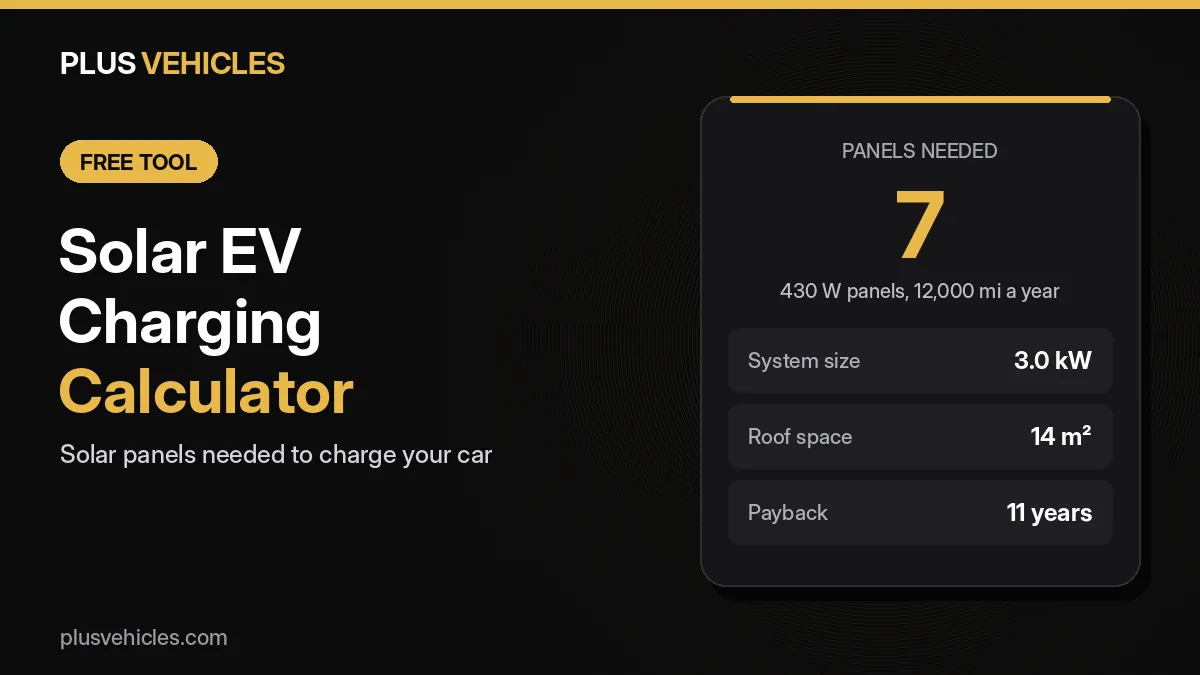
Work out how many solar panels you need to charge your electric car where you live, how much roof space they take, what they cost and how fast they pay back.
Panels needed by daily driving
Solar output is a yearly average for a well-placed, unshaded roof. A local installer can model your exact roof.
Get the most from solar and your electric car
Prices on AmazonEmporia Vue Energy Monitor
- Shows solar output and car charging live
- Helps you charge when the sun is out
- Installs in the breaker panel
ChargePoint Home Flex
- Schedule charging for sunny hours
- Adjustable 16 to 50 amps
- App tracks energy per charge
As an Amazon Associate, Plus Vehicles earns from qualifying purchases. Learn more.
Quick answer: most drivers need about 5 to 9 solar panels (400 to 430 watts each, a 2 to 4 kW system) to cover a year of electric car charging. An American driving 12,000 miles a year uses about 4,000 kWh, which takes about 7 panels at the US average sunshine; sunny places such as Arizona, Spain, Australia or Pakistan need fewer, the UK and Germany more. Use the solar EV charging calculator above for your location and driving.
Key takeaways
- Panels needed = yearly charging kWh ÷ 365 ÷ daily solar output per kW ÷ panel size in kW.
- A 430 W panel makes about 1.1 to 2.1 kWh a day on average, depending on where you live.
- Winter output can fall to a fifth of the yearly average in northern Europe, so solar covers less of your charging in winter unless you have net metering.
- Payback is fastest where electricity is expensive and sunshine is strong.
How to use the solar EV charging calculator
- Choose where you live. This loads a typical solar output, electricity price, installation cost and grid carbon intensity.
- Enter how far you drive per year and your car’s energy use. 30 kWh per 100 miles (19 kWh per 100 km) is a typical electric SUV; small cars use less.
- Pick the panel size and how much of your charging you want solar to cover.
- Open the extra settings to enter the output from a solar quote or PVWatts, your exact electricity price and the installer’s price per watt.
How many solar panels do you need to charge an electric car?
Step 1, yearly charging energy: distance per year × kWh per 100 miles ÷ 100 ÷ 0.9 for charging losses. 12,000 miles × 30 ÷ 100 ÷ 0.9 = 4,000 kWh.
Step 2, daily energy: 4,000 ÷ 365 = 11 kWh a day.
Step 3, panels: divide by the daily output of one panel. At 4.0 kWh per kW per day (US average), a 430 W panel makes 1.72 kWh a day, so 11 ÷ 1.72 = 6.4, which rounds up to 7 panels, a 3.0 kW system.
The solar output figures are typical yearly averages for a south-facing (north-facing in the southern hemisphere), unshaded roof, after normal system losses. For an exact figure for your address, use NREL PVWatts (US) or the EU PVGIS tool and type the result into the calculator.
Solar panels needed to charge an electric car, by country
Calculator results for a typical electric SUV and typical yearly driving in each place, with 430 W panels covering 100% of charging. Costs are before rebates and in local currency.
| Location | Driving per year | Charging energy | Panels | Install cost | Payback | Darkest month |
|---|---|---|---|---|---|---|
| United States (average) | 12000 mi | 4,000 kWh | 7 panels | $8,278 | 11.0 years | 60% |
| US Southwest (Arizona, Nevada, Southern California) | 12000 mi | 4,000 kWh | 6 panels | $7,095 | 9.4 years | 82% |
| US South (Texas, Florida, Georgia) | 12000 mi | 4,000 kWh | 6 panels | $7,095 | 9.4 years | 66% |
| US Northeast and Midwest | 12000 mi | 4,000 kWh | 8 panels | $9,460 | 12.6 years | 43% |
| US Pacific Northwest | 12000 mi | 4,000 kWh | 8 panels | $9,460 | 12.6 years | 30% |
| Canada | 16000 km | 3,378 kWh | 7 panels | C$8,428 | 14.7 years | 36% |
| United Kingdom | 7400 mi | 2,467 kWh | 6 panels | £4,128 | 6.4 years | 20% |
| Ireland | 16000 km | 3,378 kWh | 9 panels | €6,966 | 5.9 years | 20% |
| Germany | 13000 km | 2,744 kWh | 7 panels | €4,515 | 4.4 years | 22% |
| Netherlands | 13000 km | 2,744 kWh | 7 panels | €3,913 | 4.8 years | 21% |
| France | 12000 km | 2,533 kWh | 5 panels | €4,300 | 6.8 years | 30% |
| Spain and Portugal | 12000 km | 2,533 kWh | 4 panels | €2,064 | 4.1 years | 60% |
| Italy | 11000 km | 2,322 kWh | 4 panels | €2,752 | 4.0 years | 47% |
| Australia | 13000 km | 2,744 kWh | 5 panels | A$2,365 | 2.6 years | 72% |
| New Zealand | 12000 km | 2,533 kWh | 5 panels | NZ$5,375 | 6.4 years | 45% |
| UAE and Saudi Arabia | 20000 km | 4,222 kWh | 6 panels | AED 7,740 | 6.1 years | 77% |
| Pakistan | 12000 km | 2,533 kWh | 4 panels | Rs 206,400 | 1.6 years | 65% |
| India | 12000 km | 2,533 kWh | 4 panels | ₹94,600 | 4.7 years | 71% |
| South Africa | 15000 km | 3,167 kWh | 5 panels | R32,250 | 2.9 years | 74% |
“Darkest month” is how much of that month’s charging the panels cover. With net metering or export credits, summer surplus offsets winter. Want to know what grid charging costs you today? Try our EV charging cost calculator or read how much it costs to charge an electric car.
Can you charge an electric car directly from solar panels?
Yes, but timing matters. Panels produce most in the middle of the day, when many cars are away from home. There are three common ways to make it work:
- Net metering or export credits: you export surplus solar during the day and draw it back at night. Your yearly solar output can cover yearly charging, which is what the calculator assumes.
- Solar-aware chargers: chargers such as Zappi, Wallbox and some Tesla and Emporia setups charge the car only from surplus solar while you are at home.
- Home batteries: store daytime solar and charge the car in the evening; this adds cost but helps where export rates are low.
Frequently asked questions
How many solar panels does it take to charge an electric car?
Usually 5 to 9 panels of about 430 watts for a year of typical driving. A US driver covering 12,000 miles a year needs about 7 at average US sunshine, about 6 in the Southwest and about 8 in the Northeast or Pacific Northwest.
How many kWh does an electric car use per year?
About 3,000 to 4,500 kWh for most drivers, including charging losses. An electric SUV driven 12,000 miles a year at 30 kWh per 100 miles uses about 4,000 kWh; a small car driven 7,500 miles uses about 2,300 kWh.
Is it worth getting solar panels to charge an electric car?
Often, yes, if you own your home, have a sunny unshaded roof and pay a high price for electricity. Payback for the extra panels is usually 4 to 12 years, and panels last 25 years or more.
Can I charge my electric car with solar panels at night?
Not directly. At night you either draw grid power that your daytime solar export has credited (net metering) or power from a home battery charged by the panels during the day.
How much roof space do I need to charge an EV with solar?
About 2 square metres (21.5 square feet) per panel, so 12 to 18 square metres (130 to 190 square feet) for a typical 6 to 9 panel system.
Can solar charge an EV in winter?
Partly. In winter, solar output in the UK, Germany or Canada can fall to a fifth to a third of the yearly average, so panels sized for the whole year cover only part of December’s charging. Sunny countries such as the UAE, Pakistan, India and Australia keep most of their output.
The bottom line
A handful of solar panels can cover a year of electric car charging in most of the world, turning your roof into a fuel station. Put your location, driving and car into the solar EV charging calculator above, then get two or three installer quotes and compare their price per watt with the figure used here.